
PICABIA INTRODUCES “OPEN THE GATES OF NIGHT” AT PALAZZO REALE


Published by Sugar & Cream, Wednesday 28 October 2026
Images courtesy of Palazzo Reale
9 October 2026 – 24 January 2027 at Palazzo Reale, Milano (Curated by Anne Berest Picabia)
An immersive exhibition at Palazzo Reale explores the restless imagination of Francis Picabia, an artist who made reinvention the defining force of his practice.
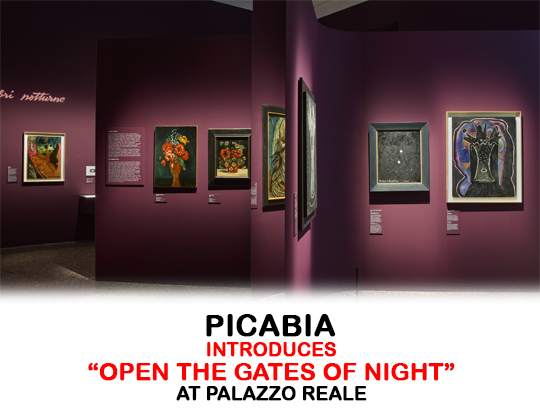
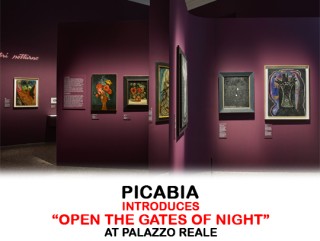
For Francis Picabia, artistic identity was never a fixed destination. Across a career spanning more than five decades, the French artist moved between styles, challenged established conventions, and repeatedly abandoned familiar visual languages in search of new possibilities. This restless approach to creation lies at the heart of Picabia. Aprire Le Porte Della Notte (Open the Gates of Night), an exhibition at Palazzo Reale in Milan that brings together more than 170 works from prestigious European museums and international collections. Curated by Anne Berest Picabia, the artist’s great-granddaughter and co-author of Gabriële, it offers the most comprehensive presentation of Picabia’s work ever held in Italy.
Rather than following a conventional chronological route, the exhibition explores the ideas, relationships, and experiences that shaped Picabia’s artistic vision. Its approach reflects the enduring relevance of an artist who resisted easy categorisation and made experimentation central to his practice. As Tommaso Sacchi, Councillor for Culture of the City of Milan, explains:
“With ‘Picabia. Open the Gates of Night’, Milan renews its commitment to promoting and sharing international artistic culture, bringing to the public a project that combines scholarly rigour, outstanding loans and an original approach. The exhibition offers an opportunity to rediscover an artist of profound innovation, whose work anticipated ideas and questions that remain deeply relevant today. Through his constant drive to experiment, reinvent himself and challenge established conventions, Picabia emerges as a figure of remarkable contemporary relevance: a key protagonist of modernity and, at the same time, a true precursor of contemporary art.”
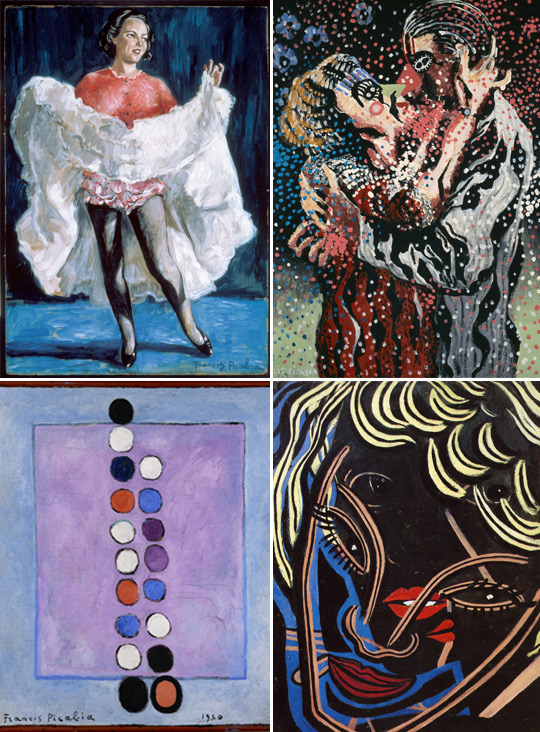
This spirit of reinvention can be traced back to Picabia’s beginnings. Born in Paris in 1879 to a Spanish father and a French mother, he moved between Paris, New York, Barcelona, Zurich, and the French Riviera, encountering influential figures such as Marcel Duchamp, Gertrude Stein, Pablo Picasso, dancer Isadora Duncan, and composer Erik Satie along the way. His artistic language evolved just as restlessly, passing through Impressionism, Fauvism, Cubism, abstraction, and Dada. For Picabia, each movement offered a new possibility rather than a permanent home. Once a style became familiar, he was inclined to leave it behind and begin again.
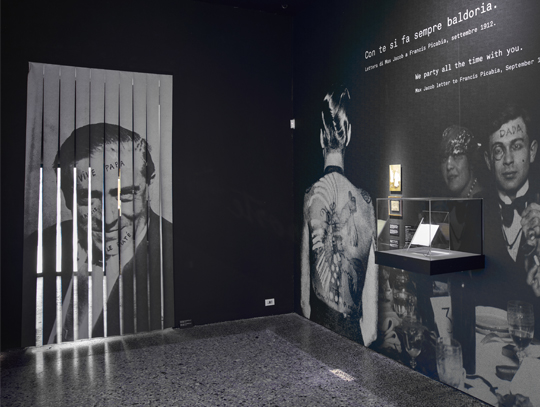
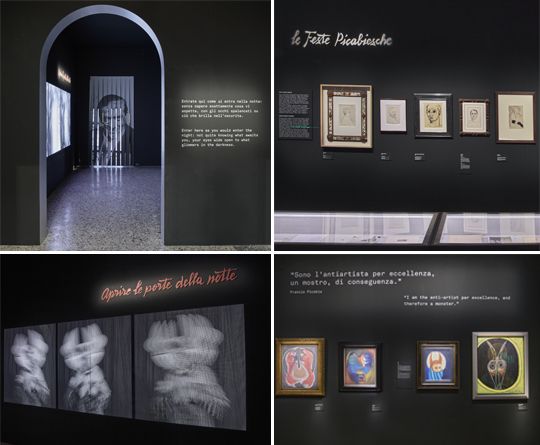
The exhibition follows this impulse through the themes that occupied his imagination, from passionate love and the rhythms of dance and music to his Spanish heritage, the experience of war, and his belief in collective creation. These subjects are presented not as isolated chapters in an artistic biography, but as interconnected forces that shaped his work and his understanding of life. The title, Open the Gates of Night, evokes the different hours of the night as gateways to new experiences and ways of seeing the world.
For Anne Berest Picabia, this appetite for experience was inseparable from the artist’s outlook on life. As she explains:
Presented by Coulisse | INK
“For him, it was not enough simply to live; one had to live twice, to live by day and by night, to live with style, transforming existence into a celebration, into an adventure pursued to the point of ecstasy.”
This view of life as an ongoing adventure finds a visual counterpart in the works on display, where images shift, familiar forms become unfamiliar, and materials are repurposed in unexpected ways. In Salicis (1929), on loan from the Centre Pompidou in Paris, Picabia explores the superimposition and metamorphosis of images through a reference to the myth of Danaë and the golden rain. The painting reflects his interest in the multiple meanings an image can hold, turning a familiar myth into an opportunity for visual experimentation.
A different kind of transformation appears in Balance (1919–20), from the Berardo Collection in Lisbon. Here, mechanical elements are isolated and enlarged, detached from their original functions, and recast as a distinctive pictorial vocabulary. The work explores the relationship between the body, movement, and inertia, revealing how Picabia could turn the language of machinery into something both abstract and evocative.
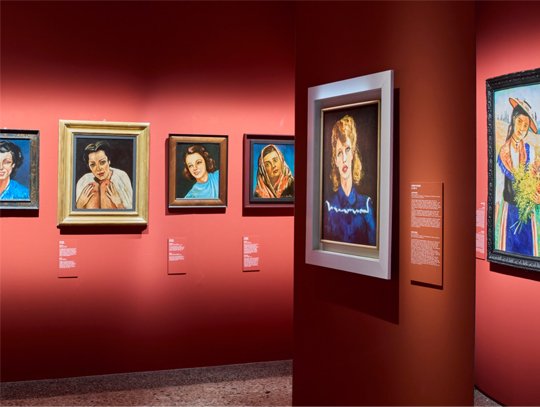
His exploration of the human figure takes another direction in Femmes au bull-dog (c. 1940–41), also on loan from the Centre Pompidou. One of his best-known works, it belongs to a cycle exploring love, female figures, and desire. These themes take on a more provocative, carnivalesque character in Mardi gras (Le Baiser) (c. 1924–25), associated with his so-called Monsters period. Through its use of colour, materials, and motifs drawn from popular culture, the work captures Picabia’s willingness to unsettle conventional ideas of beauty and representation.
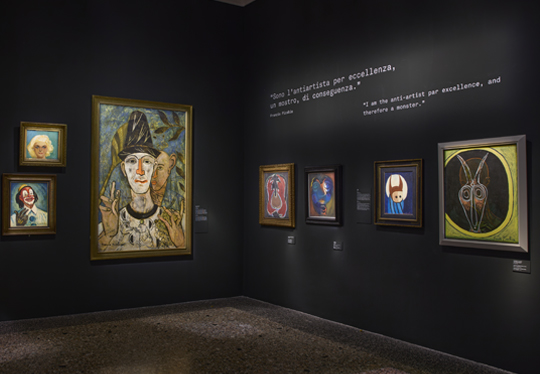
Together, these works reveal an artist who treated visual language as something to be continually tested and reshaped. The exhibition also reaches back to the early stages of his career, offering a rare opportunity to encounter Sans titre (1898), from the Roberta Cerini Baj Collection. One of Picabia’s earliest known works, the painting had previously been shown publicly only once, at an exhibition in Turin in 1974. Its return offers a point of reference for considering the many artistic directions he would explore in the decades that followed.
From these early beginnings, the exhibition moves beyond the finished works to reveal the material traces of Picabia’s creative life. Loans from the Picabia family, alongside archival materials from the Bibliothèque littéraire Jacques-Doucet in Paris, provide a closer look at the ideas and observations that surrounded his practice. Among these are thirteen of Picabia’s Black Albums, presented at the beginning of the exhibition. Filled with newspaper clippings, drawings, letters, photographs, manuscripts, invitations, pamphlets, and handwritten notes, the albums form an expansive, often fragmentary record of an artist whose curiosity extended far beyond the canvas.
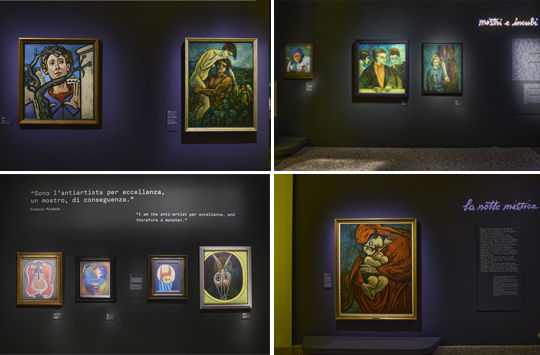
Rare photographs, personal correspondence, documents, and period albums further illuminate the relationship between Picabia’s private life and artistic development, with some materials being presented to the public for the first time. These archival elements connect the shifts in his work with the experiences, encounters, and ideas that informed them. The contribution of the Comité Picabia, whose decades-long work has focused on preserving, studying, and authenticating the artist’s oeuvre, provides an important scholarly foundation for the project.
Accompanied by a catalogue published by Skira, featuring critical essays, archival materials, and iconographic documentation, Open the Gates of Night presents Picabia not as an artist defined by a single movement or signature style, but as a figure whose creative freedom depended on the possibility of change. Through paintings, rarely seen works, and personal archives, visitors encounter an artistic practice shaped by continual departures from the familiar.
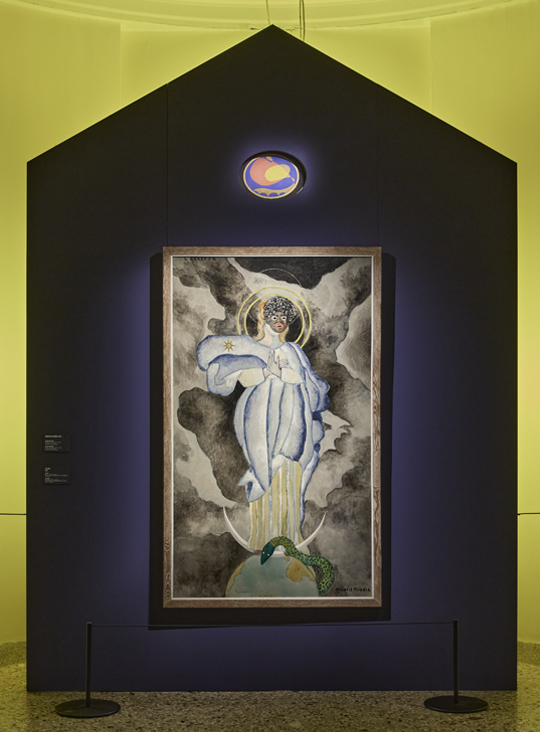
At Palazzo Reale, Picabia’s legacy unfolds not as a linear story of artistic development, but as an ongoing process of discovery. Each shift in style opens onto another way of seeing, reflecting a creative spirit that continues to resonate with contemporary artistic research.
For further information and tickets, visit Palazzo Reale.
 88
28/10/2026
PICABIA INTRODUCES “OPEN THE GATES OF NIGHT” AT PALAZZO REALE
At Milan’s Palazzo Reale, Open the Gates of Night explores Francis Picabia’s restless imagination and the curiosity that led him to continually...
read more 72
28/10/2026
ADITH DEBUTS FATIMAH AT NEW YORK FASHION WEEK
At New York Fashion Week (NYFW), ADITH brings Eastern heritage into the future with FATIMAH, its first Muslim collection for Spring/Summer 2027.
read more
 11.33K
20/10/2026
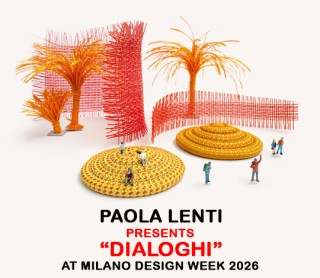
PAOLA LENTI PRESENTS “DIALOGHI” AT MILANO DESIGN WEEK 2026
At Milano Design Week 2026, Paola Lenti’s Dialoghi explores a continuous dialogue between colour, material, and space.
read more 11.14K
29/09/2026
KETTAL LONDON: WHERE FURNITURE MEETS ARCHITECTURE
Kettal’s new London flagship unfolds as a living dialogue between Eames, architecture and contemporary design.
read more

 190.77K
11/12/2024
TOTO X YUNI JIE: "TOTO in Color"
TOTO x Yuni Jie launches 'TOTO in Color', featuring an outdoor art installation and a sculpture garden inspired by Indonesia's heritage.
read more 107.37K
10/01/2025
W RESIDENCE IN SOUTH JAKARTA BY MICHAEL CHANDRA
Michael Chandra, founder of MNCO Studio Design has created the W Residence with an aesthetically pleasing, practical, and pleasant home from all...
read more


Related Articles
 5.69K
23/10/2026
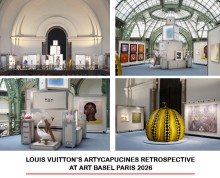
LOUIS VUITTON’S ARTYCAPUCINES RETROSPECTIVE AT ART BASEL PARIS 2026
At Art Basel Paris 2026, Louis Vuitton’s Artycapucines retrospective reveals the transformative power of collaboration, where contemporary art meets...
read more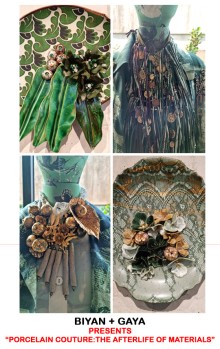 3.68K
21/10/2026
BIYAN + GAYA PRESENTS “PORCELAIN COUTURE: THE AFTERLIFE OF MATERIALS”
Biyan + Gaya: Biyan’s language of fashion meets Gaya Ceramic’s savoir-faire in porcelain, bringing two worlds of craftsmanship into a compelling...
read more